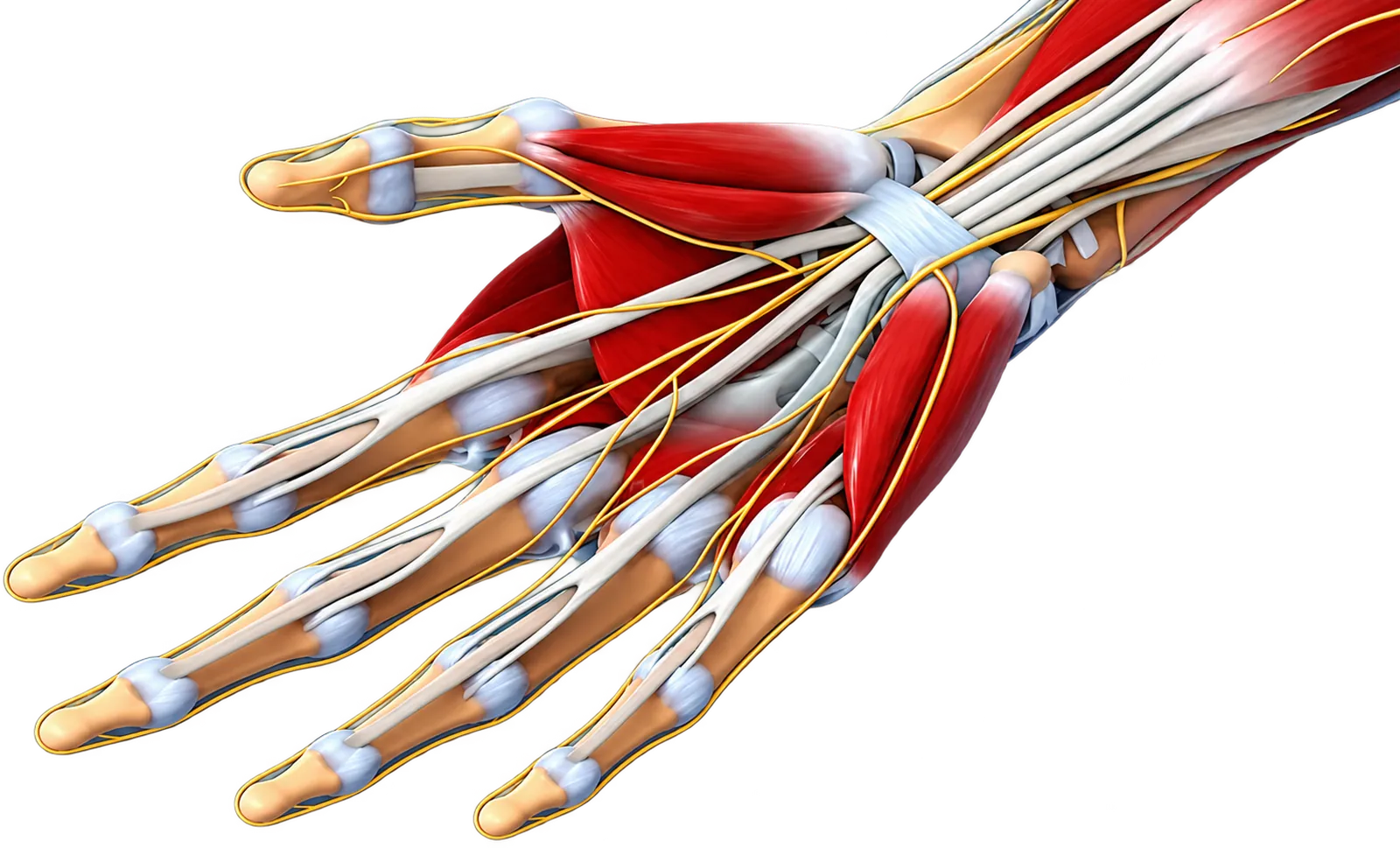
Double crush syndrome
Tingling in the hand may arise from the wrist, from the neck, or from both. This last situation has a name — double crush syndrome — and it explains part of the incomplete results after surgery.
The hypothesis was described by Upton and McComas in <em>The Lancet</em> in 1973. The principle is that proximal compression of a nerve impairs axonal transport and makes the nerve more vulnerable to a second compression downstream. A nerve already compromised at the neck would tolerate narrowing at the wrist less well.
What is firmly established is the coexistence: the two conditions occur together more often than chance would predict. A study drawing on a database of more than ninety million records found an incidence of carpal tunnel syndrome of close to ten per cent among patients with cervical radiculopathy, and showed that these patients were more likely than matched controls to have peripheral nerve compression.
What remains debated is the mechanism itself. A study of two hundred and seventy-seven C6, C7 and C8 radiculopathies found no correlation between the root level involved and the electrophysiological severity of carpal tunnel syndrome, which does not support the axonal transport explanation.
The reassuring finding
Patients with double crush syndrome improve after carpal tunnel release to a degree comparable with those without it. Double crush is therefore not a contraindication to surgery, and it should not delay treatment of proven compression at the wrist.
How I make the distinction in consultation
The picture rests on four elements. Distribution: carpal tunnel syndrome spares the little finger, whereas C8 involvement affects it; C6 involvement follows the radial border of the forearm to the thumb, beyond the median nerve territory. Timing: night-time waking that forces the patient to shake the hand is characteristic of the wrist, while pain worsened by neck movement or coughing points to the cervical spine. Provocative tests: Tinel and Phalen at the wrist, Spurling at the neck, none being sufficient in isolation. Nerve conduction studies: they localise the compression and grade its severity, but may be normal in an early cervical form.
When both are present: what to do first
My rule is to treat first what is best documented and most reversible. A carpal tunnel confirmed on nerve conduction studies, with typical night-time waking, is treated even if cervical osteoarthritis coexists. What persists is reassessed afterwards. The reverse — declining to operate on a proven carpal tunnel because cervical osteoarthritis appears on an X-ray — risks allowing a reversible nerve compression to progress.
The pitfall of radiological cervical osteoarthritis
Beyond the age of fifty, cervical osteoarthritis is almost universal on imaging. Its presence does not prove that it is symptomatic. An image explains a symptom only when the distribution matches.
What about diabetes?
Diabetes may act as the first insult without any proximal compression: a metabolically compromised nerve tolerates narrowing of the canal less well. This partly explains both the frequency and the severity of carpal tunnel syndrome in patients with diabetes.
Frequently asked questions
Do my tingling sensations come from my neck or my wrist?
The territory of the tingling, its timing and the clinical tests help distinguish the two. Carpal tunnel syndrome spares the little finger, wakes you at night and is provoked by the Tinel and Phalen tests at the wrist. A cervical cause tends to follow the arm, worsens with neck movement or coughing, and is assessed with the Spurling test. Nerve conduction studies confirm and grade the compression.
Can you have carpal tunnel syndrome and a cervical problem at the same time?
Yes. This coexistence is more frequent than chance would predict, and it has a name: double crush syndrome. A nerve already compromised at the neck appears more vulnerable to a second compression downstream at the wrist.
Should the neck be treated before operating on the wrist?
Not necessarily. My rule is to treat first what is best documented and most reversible. A carpal tunnel confirmed on nerve conduction studies with typical night-time waking is treated even if cervical osteoarthritis coexists. What persists is reassessed afterwards.
Does cervical osteoarthritis on the X-ray explain my symptoms?
Not necessarily. Beyond the age of fifty, cervical osteoarthritis is almost universal on imaging. It explains a symptom only when the distribution matches: an image alone is never enough to make the diagnosis.
Does carpal tunnel surgery work when there is also a neck problem?
Yes. Patients with double crush syndrome improve after carpal tunnel release to a degree comparable with those without it. A coexisting cervical problem is not a contraindication.
Why do my tingling sensations persist after surgery?
Several explanations are possible: nerve recovery still under way, which may take several months in long-standing cases; an untreated associated cervical compression; or, more rarely, an incomplete release. Repeat examination and comparative nerve conduction studies allow the distinction to be made.
Medical review
Written and medically reviewed by Dr Alexandre Kilinc, orthopaedic surgeon specialising in hand, wrist and upper limb surgery (RPPS 10100025286), registered with the French National Medical Council. Member of SFCM, SOFCOT, SECEC, AAOS and FESUM. Consultations and surgery at Clinique Jouvenet (Paris) and Hôpital Privé Claude Galien (Quincy-sous-Sénart).
This page is for information only and does not replace a medical consultation.
Last reviewed: 2026-09-19