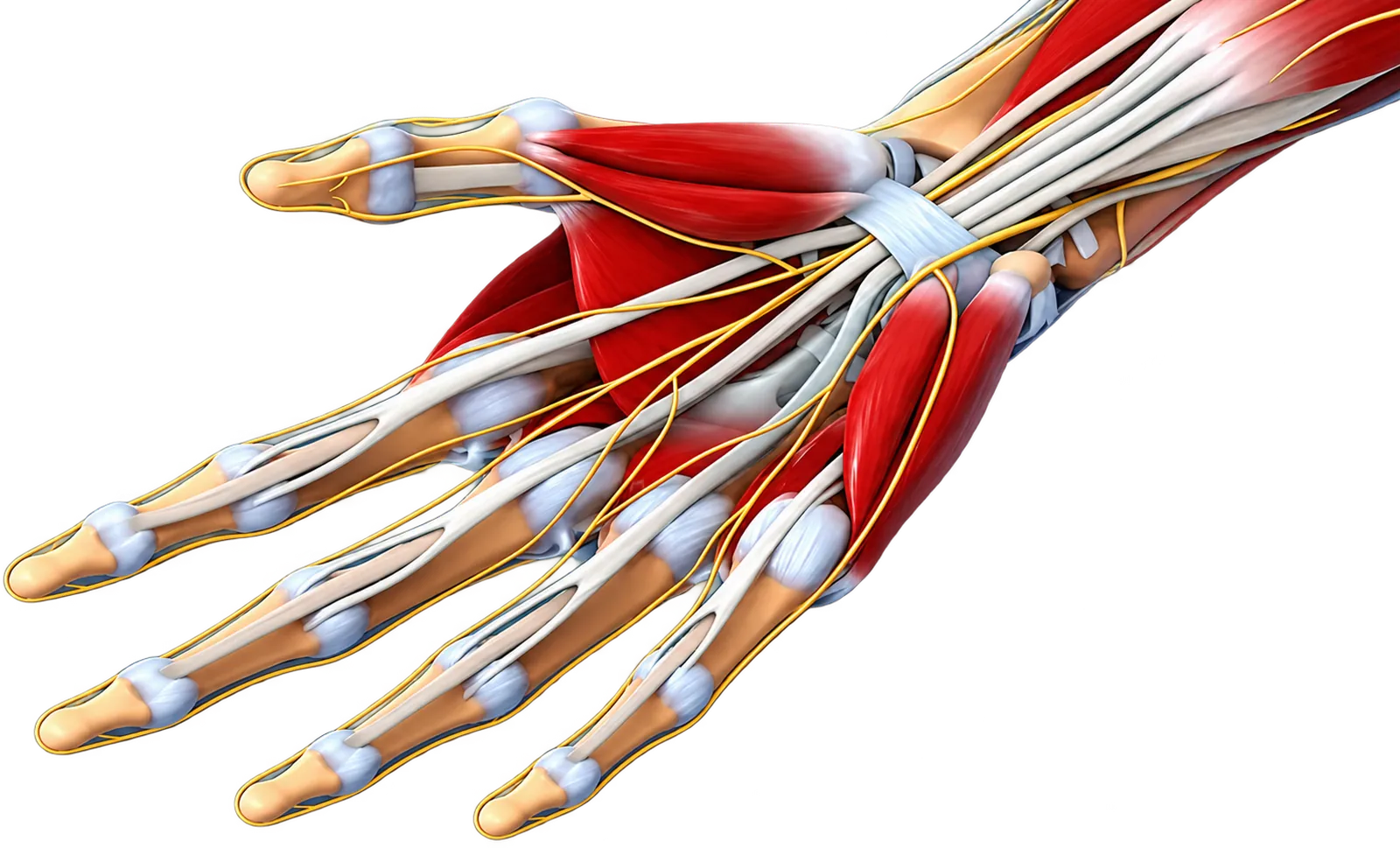
Guyon canal syndrome
The Guyon canal carries the ulnar nerve across the wrist, immediately adjacent to the carpal tunnel. Compression causes tingling in the ring and little fingers, and sometimes isolated weakness.
The Guyon canal, also called the ulnar tunnel, is a fibro-osseous passage on the anterior and medial aspect of the wrist. It was described in 1861 by Jean Casimir Félix Guyon; the reference anatomical description remains that of Gross and Gelberman, published in 1985, who measured the tunnel at four to four and a half centimetres.
It shares a wall with the carpal tunnel: its floor is formed by the transverse carpal ligament, together with the pisohamate and pisometacarpal ligaments. This proximity explains the rare possibility of simultaneous involvement of both nerves.
Unlike carpal tunnel syndrome, an idiopathic form is uncommon here: when the ulnar nerve is compressed at the wrist, a space-occupying cause should almost always be sought.
The three zones, and why they matter
The nerve divides within the tunnel, and the level of that division separates three radically different clinical pictures. Zone 1: the trunk is still mixed, and involvement is both sensory and motor. Zone 2: the deep motor branch, with purely motor involvement and no sensory disturbance. Zone 3: the superficial sensory branch, with purely sensory involvement and no motor deficit. This is the key to diagnosis: weakness of the hand without any tingling points to zone 2 and should prompt a search for a local cause, most often a ganglion cyst.
The sign that distinguishes it from the elbow
The dorsal cutaneous branch of the ulnar nerve arises proximal to the wrist. Compression within the Guyon canal therefore spares sensation over the dorsum of the hand, whereas compression at the elbow does not. This is the simplest and most discriminating test: lightly touch the back of the hand on the little-finger side.
Causes
Ganglion cyst: the most frequent cause. A cyst arising from the pisotriquetral joint occupies the canal and compresses the nerve, most often in zone 2. • Fracture of the hook of the hamate: often missed, typically in golfers or tennis players. • Ulnar artery thrombosis: hypothenar hammer syndrome, in workers who use the palm as a striking tool. • Prolonged compression: long-distance cycling, hence the name handlebar palsy. • Accessory muscle or anatomical variant: rarer forms, often discovered during surgery.
The work-up
Clinical examination, nerve conduction studies to localise the compression and grade its severity, and above all ultrasound or MRI. Imaging is far more systematic here than in carpal tunnel syndrome, because a space-occupying cause is being sought.
Treatment
Conservative first in postural forms: removing the pressure, adapting equipment in cyclists, and a night splint. Surgical when a cause is identified — cyst, fracture, thrombosis — or when there is a motor deficit. Release is performed through a short incision on the ulnar border of the wrist, with removal of the cause where one exists.
Frequently asked questions
What is the difference between the carpal tunnel and the Guyon canal?
They are two adjacent tunnels separated by the transverse carpal ligament. The carpal tunnel carries the median nerve and causes tingling in the thumb, index and middle fingers. The Guyon canal carries the ulnar nerve and causes tingling in the little finger and the ulnar half of the ring finger.
Why does my little finger tingle when my thumb is fine?
This distribution corresponds to the territory of the ulnar nerve, not the median nerve. It points to ulnar nerve compression, either at the wrist in the Guyon canal or higher up at the elbow, rather than to carpal tunnel syndrome.
How can I tell whether the compression is at the elbow or the wrist?
Sensation over the back of the hand is the best guide. It depends on a branch arising proximal to the wrist, so it is normal in Guyon canal compression and impaired in compression at the elbow. Nerve conduction studies confirm the level.
Can cycling cause this syndrome?
Yes. Prolonged pressure of the heel of the hand on the handlebar during long rides can compress the ulnar nerve at the wrist. This form is known as handlebar palsy and often resolves once position, gloves and grips are adapted.
Why an ultrasound when it is not always done for the carpal tunnel?
Because an idiopathic form is uncommon in the Guyon canal. A space-occupying cause — cyst, thrombosis, fracture, accessory muscle — is almost always sought, and imaging is the only way to identify it before surgery.
Can you have both syndromes at the same time?
It is possible but uncommon. The two tunnels are adjacent and share a wall. An association should prompt a search for a systemic cause such as rheumatoid arthritis, amyloidosis or diabetes.
Medical review
Written and medically reviewed by Dr Alexandre Kilinc, orthopaedic surgeon specialising in hand, wrist and upper limb surgery (RPPS 10100025286), registered with the French National Medical Council. Member of SFCM, SOFCOT, SECEC, AAOS and FESUM. Consultations and surgery at Clinique Jouvenet (Paris) and Hôpital Privé Claude Galien (Quincy-sous-Sénart).
This page is for information only and does not replace a medical consultation.
Last reviewed: 2026-09-19