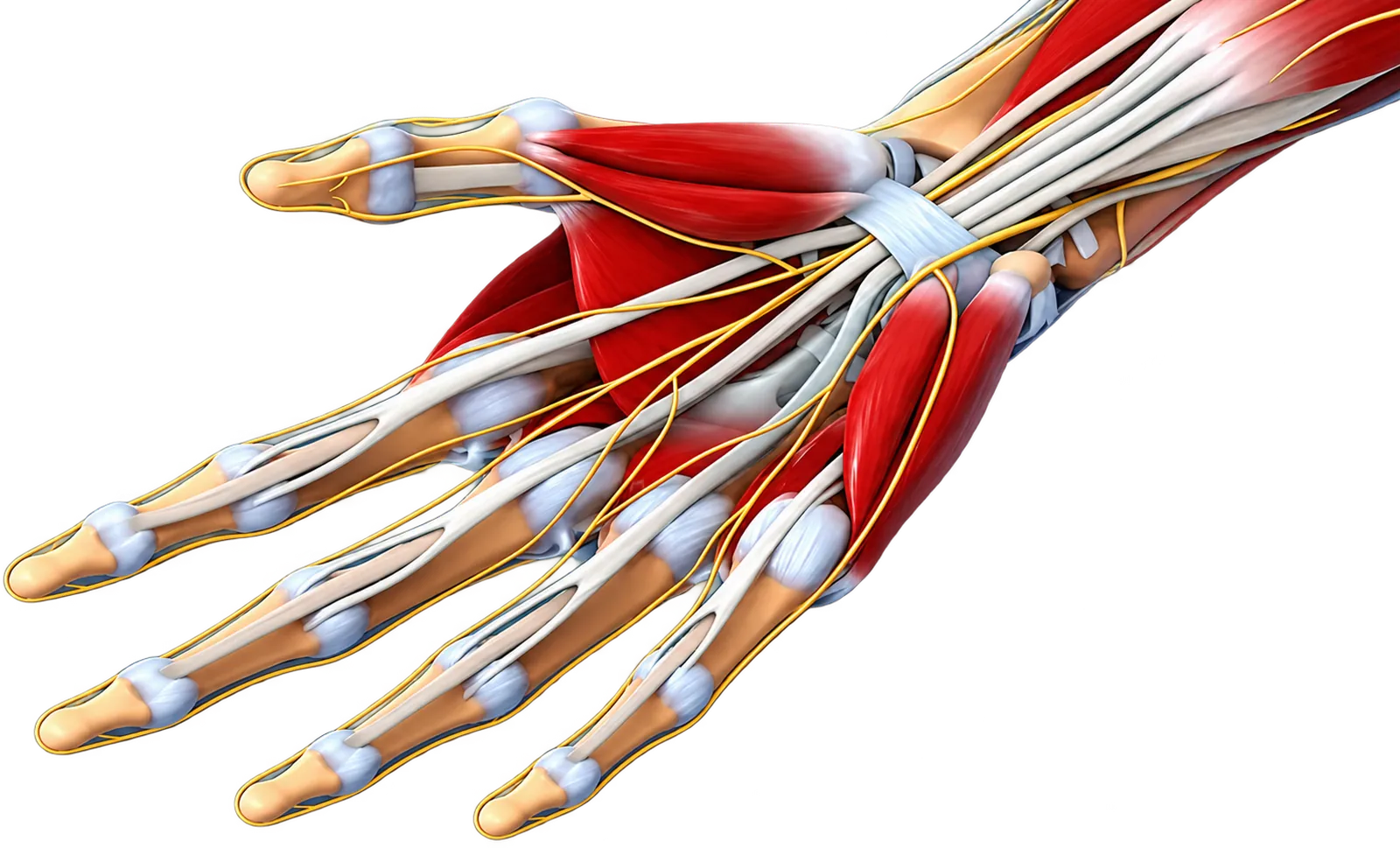
Surgical techniques for carpal tunnel release
Three approaches can be used to release the median nerve: endoscopic video-surgery, classic open surgery and ultrasound-guided surgery. Dr Kilinc performs all three.
Open release uses a palmar incision of two to three centimetres and remains the historical reference, particularly for revision surgery and secondary causes.
Single-portal endoscopic release is performed through one mini-incision at the wrist crease, dividing the ligament under video control while preserving the skin and soft tissues of the palm.
The choice of technique depends on anatomy, the severity of compression and previous surgery: it is discussed with the patient in consultation.
Whichever technique is chosen, the procedure is performed in an operating theatre, as day surgery, at Clinique Jouvenet (Paris 16e) and Hôpital Privé Claude Galien (Quincy-sous-Sénart).
Mastering all three techniques: the condition for an individualised choice
A surgeon who masters only one technique will necessarily offer that technique to every patient. Having all three approaches available makes it possible to start from the patient rather than from the available instrument: wrist anatomy, severity of compression on electromyography, previous surgery, associated conditions and occupational demands. Choosing a technique means, first of all, knowing when not to choose it.
- Anatomical variants: bifid median nerve, persistent median artery, transligamentous course of the thenar motor branch.
- Recurrence or revision surgery, where fibrosis alters the anatomical landmarks.
- Secondary carpal tunnel syndrome: inflammatory tenosynovitis, rheumatoid arthritis, dialysis, diabetes, hypothyroidism, pregnancy.
- Suspected transthyretin amyloidosis, particularly with bilateral involvement in men over 60: a diagnostic biopsy of the tenosynovium and transverse carpal ligament is most straightforward through an open approach, but remains feasible endoscopically by delivering a flexor tendon through the proximal incision. Open surgery retains the advantage when the tenosynovium is sparse or exposure is difficult.
- Associated procedures: trigger finger, De Quervain's tenosynovitis, ulnar nerve release at the elbow, ganglion cyst.
Endoscopic video-surgery
Endoscopic release uses a mini-camera introduced through a small incision at the wrist crease. The transverse carpal ligament is divided under video control, with a direct and magnified view of the structures: the position of the median nerve is not inferred, it is seen. The scar, a few millimetres long, lies outside the weight-bearing area of the palm, which limits scar tenderness and often allows a faster return to activity.
Classic open surgery
Open release involves an incision in the palm to reach the carpal ligament directly and divide it under direct vision. It remains particularly useful in recurrences, complex anatomy, certain secondary causes, and whenever a generous diagnostic biopsy is required.
Ultrasound-guided surgery
Ultrasound-guided release is performed under ultrasound control through a very small incision. It can be of interest in selected indications, but anatomical structures and the median nerve are visualised only indirectly, through their ultrasound image. Its accuracy rests entirely on continuous interpretation of the images during the procedure, which requires specific ultrasound expertise.
A surgical procedure belongs in an operating theatre
Releasing the transverse carpal ligament is a surgical procedure in its own right: it opens an anatomical space containing a nerve, an artery and nine flexor tendons within their synovial sheath. Day surgery means the patient goes home the same day; it does not mean the procedure is carried out outside a surgical facility.
- Asepsis: filtered air handling, a dedicated patient pathway, traceable instrument sterilisation, a trained team and the surgical safety checklist.
- Anaesthetic safety: vasovagal episodes, reactions to local anaesthetic, bleeding or a poorly tolerated tourniquet are managed immediately.
- The ability to convert to open surgery within the same operating session: conversion is not a failure but the normal safety net of minimally invasive surgery, and it is only possible if it has been anticipated.
The guidance changes; the procedure remains surgical
Ultrasound is a guidance method: it does not change the nature of the intervention. This procedure is today performed by various specialists, including interventional radiologists, whose ultrasound expertise is real and well recognised. Dr Kilinc's choice, as a hand surgeon, is to combine in the same hands the ultrasound expertise required for guidance and the surgical expertise required to convert, to treat an injury to a nerve, tendon or vessel, to revise an incomplete release and to provide follow-up as well as any revision surgery. The person who performs the procedure should be the person able to manage all of its consequences.
Useful questions to ask before carpal tunnel surgery
Whichever practitioner is consulted, four questions allow proposals to be compared on objective criteria.
- Which techniques do you perform: one, or all three?
- Where will the procedure take place: in an operating theatre, or in a medical office?
- If a difficulty arises during the procedure, can it be converted to open surgery immediately, on site, by the same operator?
- Who will provide the follow-up and, if needed, any revision surgery?
How is the right technique chosen?
The decision takes into account symptoms, electromyography results, wrist anatomy, previous surgery and the patient's expectations. The goal remains the same: to fully decompress the median nerve while limiting the post-operative course.
Frequently asked questions
Which technique is preferred for a first carpal tunnel operation?
Endoscopic video-surgery is often preferred when it suits the patient's anatomy. Open surgery or ultrasound-guided surgery may be indicated depending on previous surgery, the cause of the compression and the expertise available.
Is endoscopic surgery more effective than open surgery?
Both techniques release the median nerve with good results. Endoscopy can reduce scar tenderness and speed up the return to activity, while open surgery retains an important role in recurrences and complex situations.
How long does carpal tunnel surgery take?
The procedure itself usually takes a few minutes and is performed as day surgery. The total length of the visit depends on the anaesthesia, the preparation and the monitoring afterwards.
Can carpal tunnel surgery be performed in a medical office?
Technically, some minimally invasive techniques allow the procedure to be carried out outside an operating theatre. In Dr Kilinc's practice, the procedure is always performed in an operating theatre, as day surgery, for three reasons: surgical asepsis, anaesthetic safety, and the ability to convert immediately to open surgery should a difficulty arise.
Does ultrasound-guided carpal tunnel release have to be performed by a surgeon?
Ultrasound is a guidance method: the procedure itself remains surgical. Performed by a hand surgeon, it combines the ultrasound expertise required for guidance with the surgical expertise required to manage the unexpected, convert to open surgery, treat a complication and provide follow-up as well as any revision procedure.
What happens if a difficulty arises during minimally invasive surgery?
The procedure is converted to open surgery within the same operating session. Conversion is not a failure but a planned safety measure: it requires operating in a theatre, with the instruments, anaesthesia and team needed to carry it out immediately.
Why perform all three techniques rather than just one?
Because the choice should start from the patient, not from the available instrument. Anatomical variants of the median nerve, recurrence, secondary causes, associated procedures: some situations require open surgery, others are ideally suited to endoscopy. Mastering all three techniques is what makes genuine individualisation possible.
Which technique leaves the smallest scar?
Ultrasound-guided surgery and endoscopic video-surgery both leave a scar of a few millimetres, located at the wrist crease rather than in the weight-bearing area of the palm. Endoscopy adds the advantage of direct visual control of the median nerve and the ligament during the release.
Medical review
Written and medically reviewed by Dr Alexandre Kilinc, orthopaedic surgeon specialising in hand, wrist and upper limb surgery (RPPS 10100025286), registered with the French National Medical Council. Member of SFCM, SOFCOT, SECEC, AAOS and FESUM. Consultations and surgery at Clinique Jouvenet (Paris) and Hôpital Privé Claude Galien (Quincy-sous-Sénart).
This page is for information only and does not replace a medical consultation.
Last reviewed: 2026-09-07