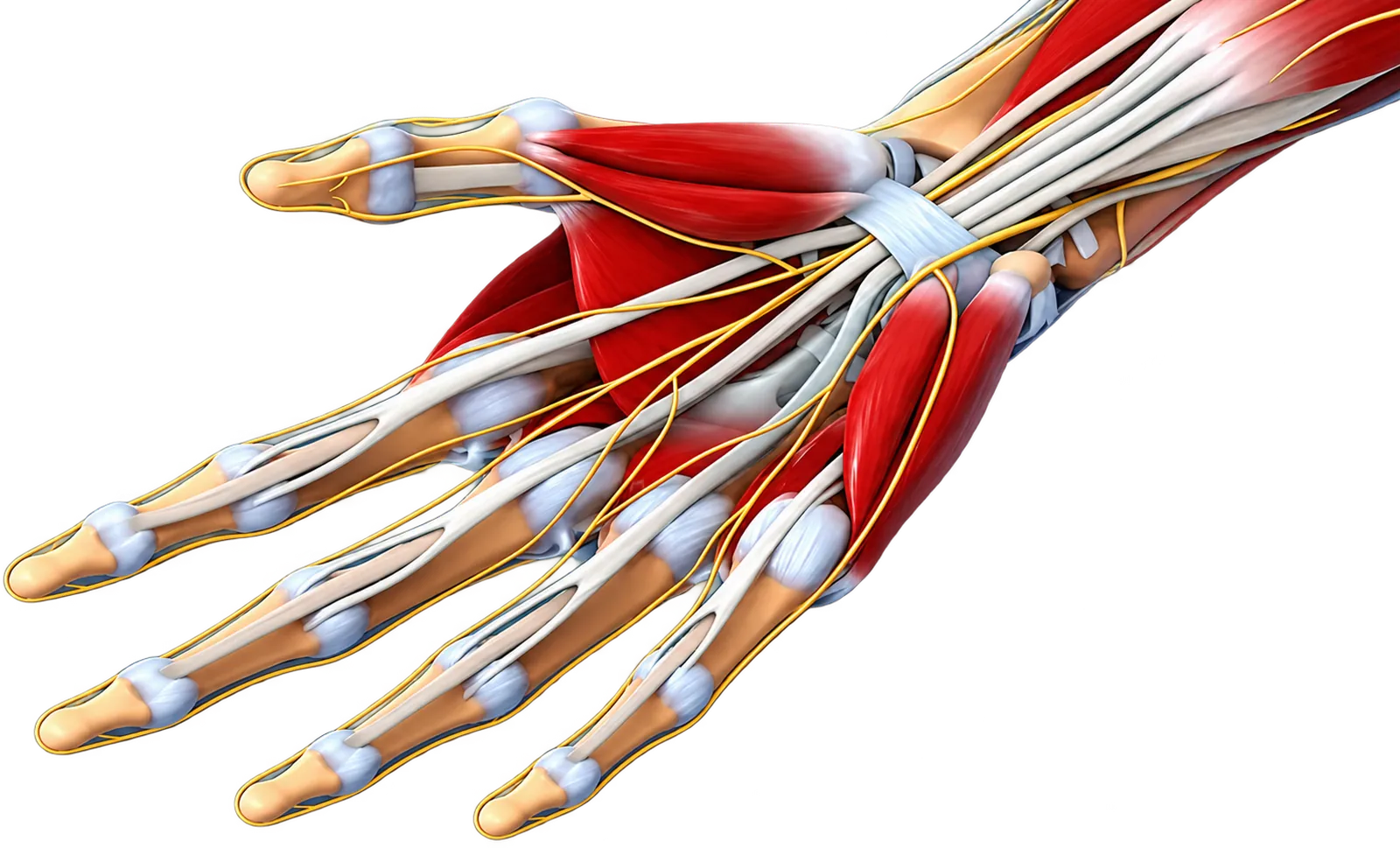
Surgical treatment of carpal tunnel syndrome
Surgery is the reference treatment: it permanently relieves compression by dividing the transverse carpal ligament.
The principle is simple. Division of the flexor retinaculum enlarges the tunnel and removes the pressure on the median nerve. The divided ligament then heals in a lengthened position, without functional consequence.
The procedure is performed as day surgery, with no hospital stay, under regional or pure local anaesthesia depending on the technique and clinical context.
Two approaches are possible: endoscopic release, minimally invasive and performed under camera guidance, and open release. The choice is discussed case by case according to anatomy, previous surgery and clinical context.
When to operate
Surgery is indicated after failure of well-conducted conservative treatment, or immediately in the presence of warning signs: persistent symptoms despite a night splint and injection • disabling and repeated night-time waking • constant numbness of the fingers • loss of strength or clumsiness in grip • wasting of the thenar eminence • severe involvement confirmed on nerve conduction studies.
Information about risks
As with any procedure, carpal tunnel release carries risks, which are explained during consultation: recurrence, stiffness, complex regional pain syndrome, chronic pain, together with the risks common to all surgery — infection, haematoma, wound healing problems. Prevention of complex regional pain syndrome with vitamin C is usually prescribed.
Frequently asked questions
Is carpal tunnel surgery painful?
Recovery is generally not very painful and simple analgesics are usually sufficient. Discomfort on pressure at the heel of the hand, known as pillar pain, is common and settles progressively.
Do I need to stay in hospital?
No. The procedure is performed as day surgery: you come in and go home the same day, with no overnight stay.
Do symptoms disappear immediately?
Night-time waking usually settles very quickly, sometimes from the first nights. Recovery of sensation and strength may however take several months in long-standing or severe cases.
Can carpal tunnel syndrome recur after surgery?
True recurrence is rare when release has been complete. Persistent symptoms should prompt a search for incomplete release, another cause of nerve compression, or nerve damage already established before surgery.
Medical review
Written and medically reviewed by Dr Alexandre Kilinc, orthopaedic surgeon specialising in hand, wrist and upper limb surgery (RPPS 10100025286), registered with the French National Medical Council. Member of SFCM, SOFCOT, SECEC, AAOS and FESUM. Consultations and surgery at Clinique Jouvenet (Paris) and Hôpital Privé Claude Galien (Quincy-sous-Sénart).
This page is for information only and does not replace a medical consultation.
Last reviewed: 2026-08-21