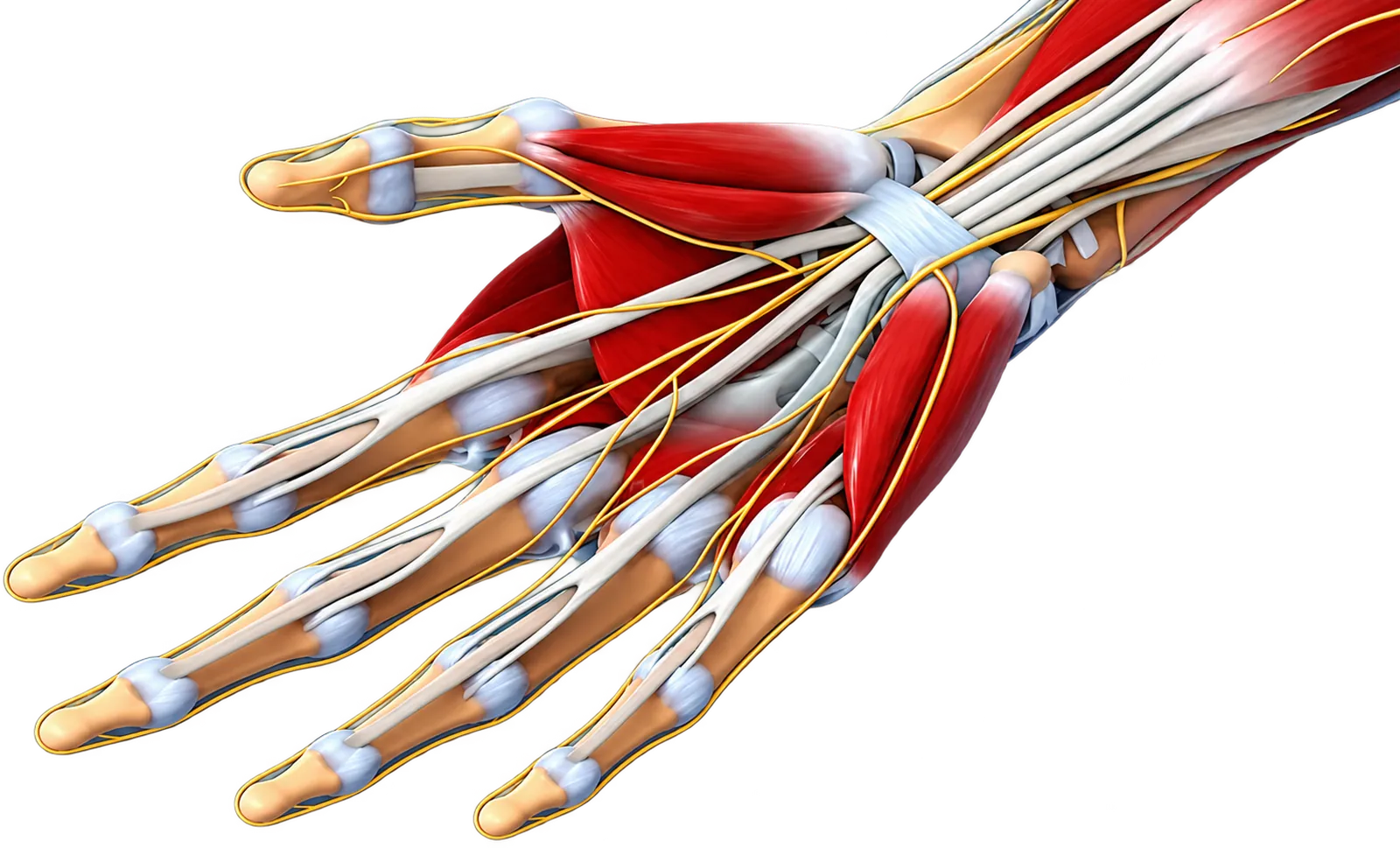
Symptoms of carpal tunnel syndrome
Night-time tingling in the first three fingers, forcing the patient to shake the hand for relief, is the most suggestive sign.
Paraesthesia — pins and needles, tingling, electric shock sensations — typically affects the thumb, index finger, middle finger and the outer half of the ring finger, the territory of the median nerve. The little finger is usually spared.
Symptoms commonly occur at night and wake the patient. Relief is sought by shaking the hand, letting it hang out of the bed, or running it under water.
During the day, symptoms are triggered by sustained wrist positions: holding a steering wheel, a phone, a book, or performing repetitive manual work.
Signs of progression
When compression persists, paraesthesia becomes constant and gives way to continuous numbness. Loss of strength and clumsiness follow: difficulty fastening a button, holding a needle, objects slipping from the hand. At an advanced stage, thenar wasting appears — a visible hollowing of the muscle at the base of the thumb, indicating motor involvement. Key signs: night-time tingling in the first three fingers • waking and shaking the hand • daytime numbness in sustained positions • pain radiating to the forearm or shoulder • loss of fine grip • thenar wasting in severe cases.
Frequently asked questions
Why do carpal tunnel symptoms occur at night?
During sleep the wrist naturally adopts a flexed position, which raises pressure inside the carpal tunnel. Night-time venous stasis also contributes. This is why wearing a resting splint at night often relieves early forms.
Can the pain radiate up the arm?
Yes. Pain may radiate to the forearm, elbow and sometimes the shoulder. This ascending radiation does not question the diagnosis, but it does require an associated cervical problem to be excluded.
When should I see a specialist?
As soon as night-time waking becomes regular, or in the presence of constant numbness, loss of strength or clumsiness of the hand. These last signs indicate more advanced nerve involvement.
Medical review
Written and medically reviewed by Dr Alexandre Kilinc, orthopaedic surgeon specialising in hand, wrist and upper limb surgery (RPPS 10100025286), registered with the French National Medical Council. Member of SFCM, SOFCOT, SECEC, AAOS and FESUM. Consultations and surgery at Clinique Jouvenet (Paris) and Hôpital Privé Claude Galien (Quincy-sous-Sénart).
This page is for information only and does not replace a medical consultation.
Last reviewed: 2026-08-21