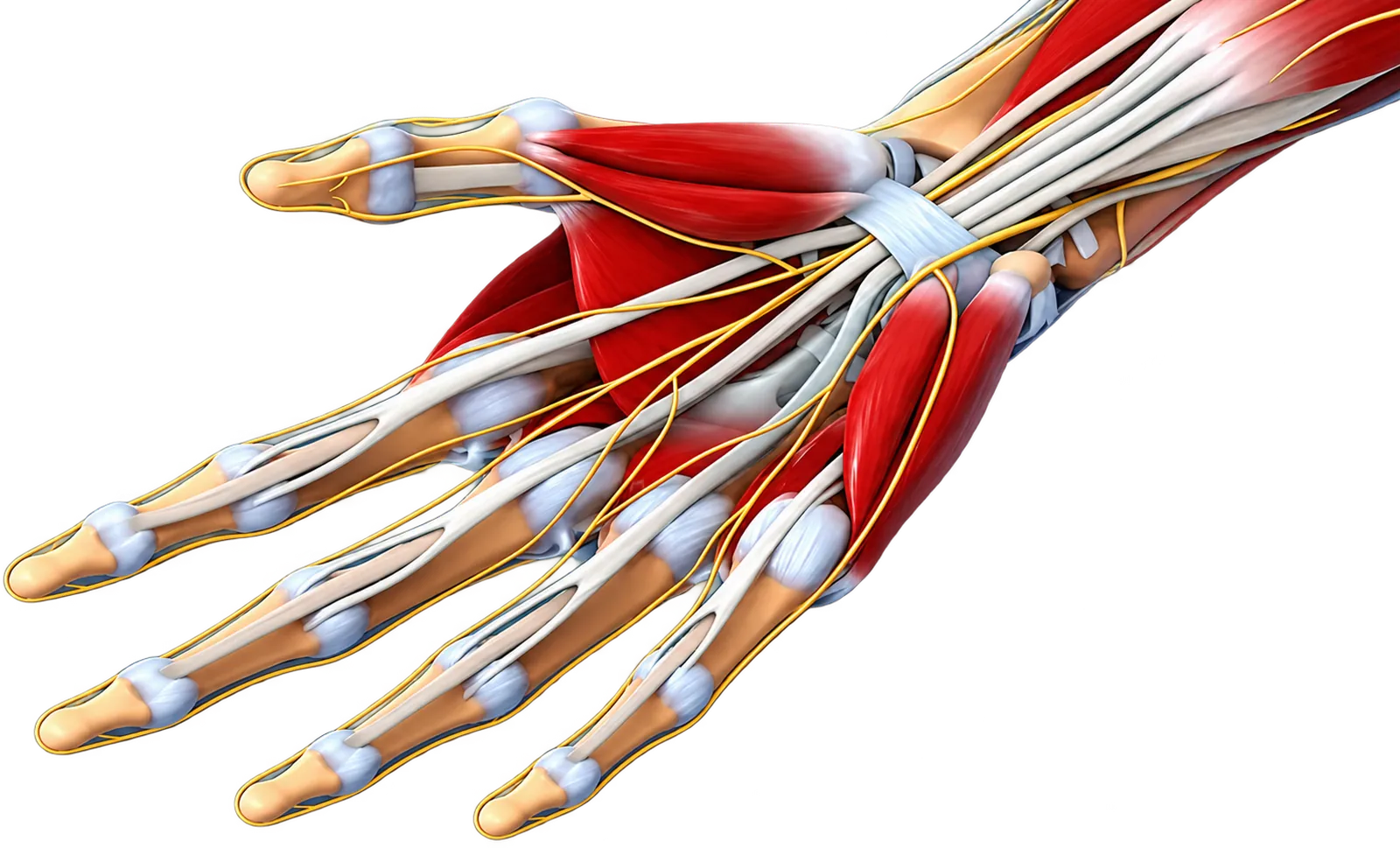
Carpal tunnel syndrome, trigger finger, De Quervain's tenosynovitis and thumb base arthritis are four separate conditions, but they share the same biological background and the same anatomical crossroads, around the trapezium and the wrist. It is therefore common for one patient — most often a woman between 45 and 65 — to develop them one after the other over a few months or years. This clustering is neither bad luck nor a surgical complication: it reflects a single underlying fragility of the connective tissue of the hand.
One anatomical crossroads
The trapezium, the small bone at the base of the thumb, forms the outer wall of the carpal tunnel. A few millimetres away, the flexor tendons glide under the transverse carpal ligament and then under the digital pulleys, while the tendons of the first dorsal compartment — those involved in De Quervain's disease — run just beyond. Everything happens within less than three centimetres.
When the gliding tissues thicken, several neighbouring structures suffer at once: the median nerve is compressed, the flexor tendon catches under its pulley (trigger finger), and the thumb joint wears down and becomes painful (thumb base arthritis). This cluster is sometimes referred to as peritrapezial disease.
A shared background, documented by research
Tissue taken at surgery for idiopathic carpal tunnel syndrome shows non-inflammatory fibrosis of the subsynovial connective tissue, with disorganised collagen bundles and new vessel formation. Trigger finger involves a comparable mechanism: a size mismatch between a thickened flexor tendon and a narrowed A1 pulley.
The link is also genetic. A genome-wide association study of almost 3,000 patients with trigger finger and more than 400,000 controls identified a susceptibility locus shared with carpal tunnel syndrome (DIRC3-IGFBP5) — an inherited predisposition common to both conditions.
Shared risk factors add to this picture: menopause, diabetes, hypothyroidism, rheumatoid arthritis, renal disease, obesity and repetitive forceful hand use.
What the numbers show
- Among 633 hands operated on for idiopathic carpal tunnel syndrome, radiographic thumb base arthritis was present in 34%, and trigger finger or De Quervain's disease in 13% before surgery.
- Among patients undergoing thumb basal joint surgery, associated carpal tunnel syndrome reached 43%.
- On clinical examination, one series found both conditions in 61% of patients consulting for either one.
In short: when one of these conditions is diagnosed, the others should be looked for.
Symptoms appear in waves, rarely all at once
Symptoms almost always appear staggered over time, not simultaneously. A typical patient describes night-time pins and needles for one or two years, then, several months later, a middle or ring finger catching on waking, and later still pain at the base of the thumb when turning a key. The second hand often follows the first by a few years.
The reason is simple: the tissue changes slowly, and each structure reaches its tolerance threshold at a different moment. Trigger finger in particular tends to show up first in the morning, as a finger locked in flexion that has to be straightened with the other hand, before becoming constant.
Carpal tunnel surgery does not cause trigger finger
This is the most frequent question in clinic, and the answer deserves precision.
It is true that trigger finger appears in about 7.7% of patients within the year following carpal tunnel release, with a mean delay of five to six months. But three arguments show this is co-occurrence, not a consequence of the operation:
- Patients whose carpal tunnel syndrome is managed without surgery also develop trigger fingers, at a high rate and within a comparable delay — roughly eight weeks from diagnosis in both groups.
- In the largest comparative study (16,768 propensity-matched patients), the excess of trigger fingers in operated patients was also found in the contralateral, non-operated hand. No surgical procedure can explain triggering on the other side: it is the patient, not the operation, who is predisposed.
- A hand affected by carpal tunnel syndrome shows more trigger fingers than the unaffected hand of the same patient, regardless of any treatment.
There is also a detection effect: once the tingling and the night pain are gone, patients finally notice a catching that was already there but was masked by the background noise of the carpal tunnel. This is why I systematically examine the pulleys and the thumb joint before surgery, and why it is stated in the preoperative information.
A mechanical hypothesis remains under discussion in the literature — dividing the transverse carpal ligament would alter the entry angle of the tendons under the A1 pulley — but it is not established, and the coincidence-versus-complication debate is still open.
Prognosis and course
Taken individually, these conditions have a good prognosis. Carpal tunnel release stops night-time waking within days; recovery of sensation and strength depends on how long the nerve has been compressed, which is an argument against waiting too long. Trigger finger responds well to a corticosteroid injection, and A1 pulley release is a short, reliable procedure when injection fails. Thumb base arthritis evolves over years and is first managed with a splint, therapy and injections, with surgery reserved for failure of these measures — as does finger osteoarthritis generally.
The key point: treating one site neither protects the others nor makes them worse. Follow-up means monitoring the three remaining sites, not fearing the operation that was performed. On recovery and return-to-activity timescales, see the update on sick leave and getting back to normal.