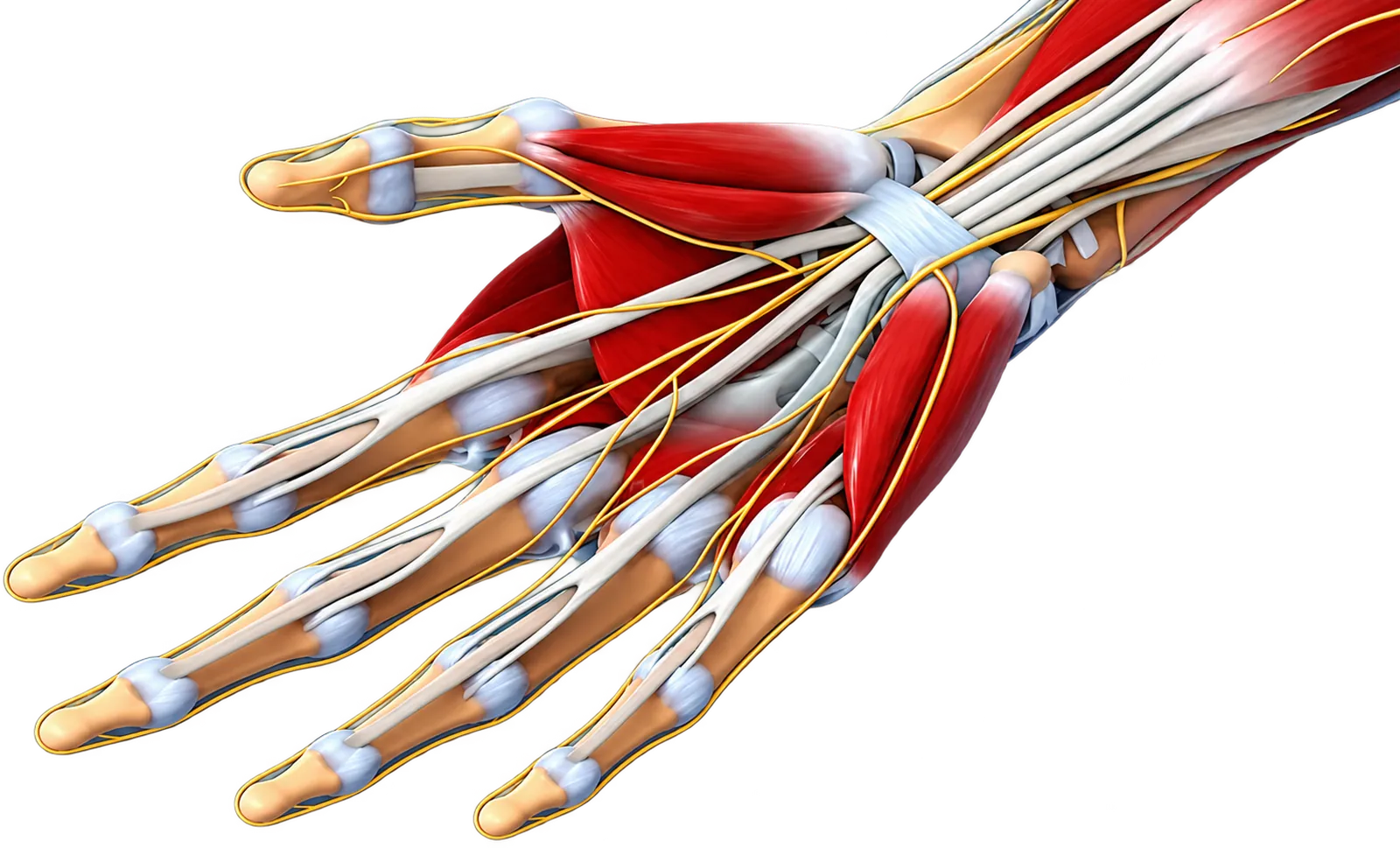
The vast majority of patients operated on for carpal tunnel syndrome are relieved. For a small minority, symptoms persist or return. This is neither inevitable nor mysterious: the causes are known, and the first task is to distinguish them.
Three different situations, not to be confused
Everything rests on a single question: was there, after the operation, an interval without symptoms? The answer classifies the situation into one of three categories, each with a different dominant cause.
| Situation | Definition | Dominant cause |
|---|---|---|
| Persistence | Symptoms present beyond three months, with no symptom-free interval | Incomplete release, or incorrect initial diagnosis |
| Recurrence | Reappearance after a symptom-free interval of at least three months | Perineural cicatricial fibrosis |
| New symptoms | Onset of a disorder that did not exist before | Intraoperative injury to a nerve branch |
This classification is not academic: it entirely determines the management.
Figure 1 — Persistence, recurrence or new symptom: a three-branch decision tree from a single question.
What is the real frequency
In other words: it is rare, but not exceptional, and it concerns enough patients to warrant a page.
The first cause: incomplete release
In persistent forms, incomplete release of the ligament is the leading cause — found in about half the cases in a revision series. The two zones at fault are the distal portion of the ligament and, proximally, the antebrachial fascia at the wrist crease.
It is a mechanical cause, identifiable, and correctable.
The second: cicatricial fibrosis
In true recurrences, fibrosis surrounding the median nerve is found in almost every case. The nerve has been released but is adherent: it no longer glides. The picture is different — a symptom-free interval, then gradual reappearance.
The third: it was not carpal tunnel syndrome
Immediate persistence, without any improvement, should prompt reconsideration of the initial diagnosis. The main pitfalls:
- Predominant cervical involvement
- Proximal compression of the median nerve — pronator teres syndrome
- Diabetic neuropathy
- Thoracic outlet syndrome
- Associated ulnar nerve compression
What is not a failure
A nerve compressed for a long time takes time to recover. The disappearance of night-time waking is often immediate; sensation and strength may take several months, sometimes more than a year in severe forms. Slow recovery is not a failure.
Likewise, pain at the heel of the hand — pillar pain — is common and regresses spontaneously in the vast majority of cases.
How the diagnosis is made
- Reviewing the historyWas there a symptom-free interval after surgery, and for how long? This is the question that classifies the situation.
- Clinical examinationTopography of symptoms, Tinel's sign over the scar, search for injury to the palmar cutaneous branch.
- Nerve conduction studiesA new study, compared with the previous one: it is the comparison that is informative, more than the absolute value.
- UltrasoundAnalysis of the ligament, search for incomplete release, assessment of nerve gliding within the canal.
- Diagnostic injectionTransient relief after a corticosteroid injection predicts the outcome of revision surgery in a high proportion of cases.
What can be done
Revision surgery is tailored to the identified mechanism — not the other way around. An incomplete release is completed. Fibrosis is treated by neurolysis, sometimes combined with coverage by a hypothenar fat flap. A nerve injury requires repair.
A recent systematic review concludes that revision generally improves symptoms, with no technique demonstrating superiority: planning must be guided by the mechanism of failure.
Factors associated with a poorer outcome
High preoperative pain, long-term analgesic use, persistent rather than recurrent symptoms, and above all more than one previous revision. These elements are set out before any decision, because they bear on the expected outcome.