In an emergency in France, call 15. This page is an information document: it replaces neither an emergency call nor a medical examination. It exists because the first hours often decide the final result, and because many useful actions — and many mistakes — happen before arrival at hospital.
A wound that barely bleeds is not a minor wound
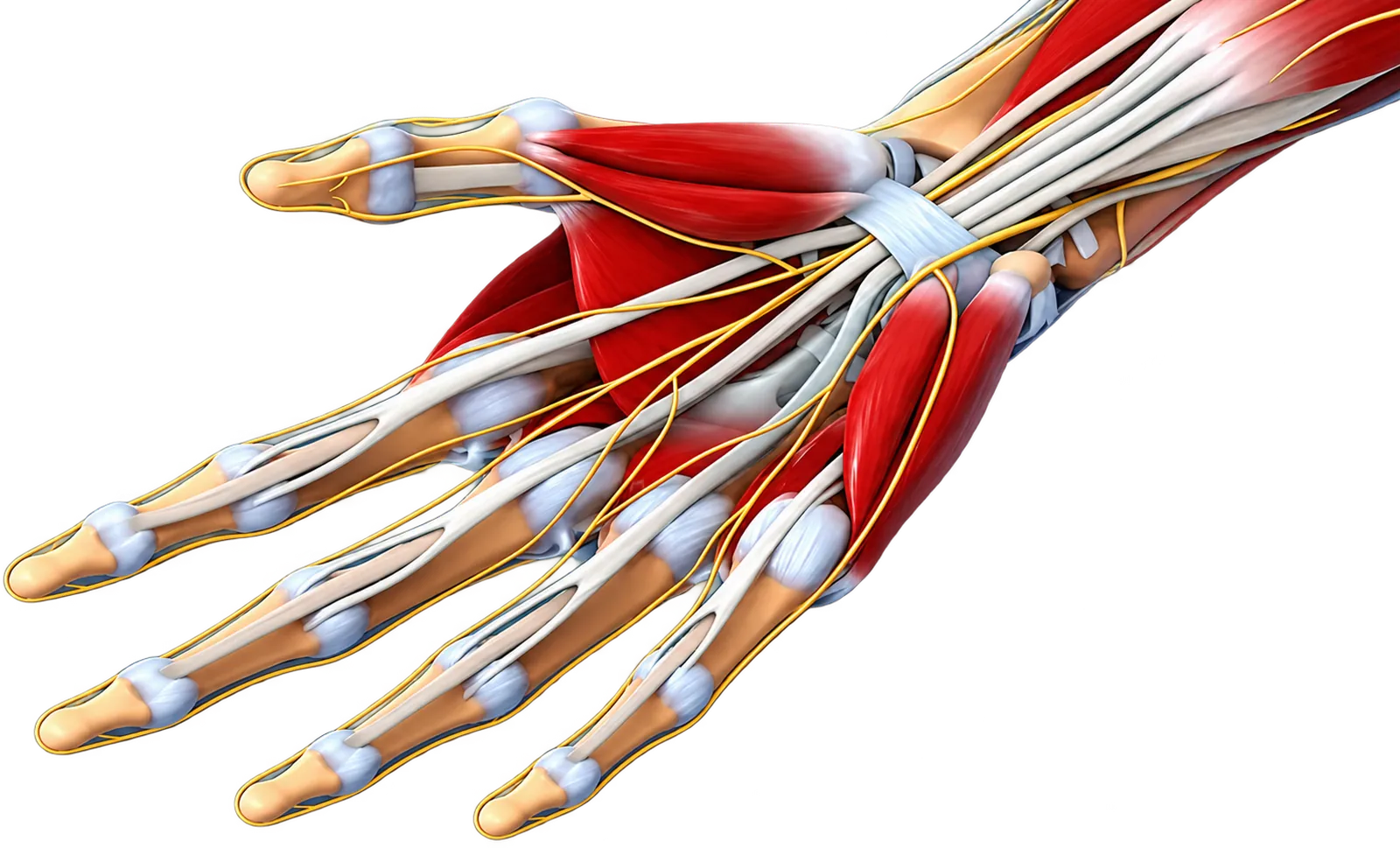
Within a few millimetres of skin, the hand packs tendons, digital nerves, arteries and joints. A clean cut from a knife or glass can divide a flexor tendon or a nerve without heavy bleeding, because the divided structures retract. Bleeding is therefore a poor indicator of severity.
Signs that require specialist assessment without delay:
- a finger that no longer bends, or bends at only one joint;
- a numb area, or persistent tingling in a defined territory;
- a wound over a flexion crease, however small;
- a bite, especially a cat bite or a human bite — the infection risk is major and the initial appearance always reassuring;
- a high-pressure injection (paint, grease, solvent): the entry point is tiny, the injury is deep and spreading — an absolute surgical emergency;
- a cold, white or blue finger with no refill;
- any amputation, even partial, even of the fingertip pulp.
The first six hours: what to do
Call the emergency number, which will direct you to a suitable service. Meanwhile:
- apply direct pressure with a clean cloth and elevate the hand; never apply a tourniquet;
- remove rings, bracelets and watch immediately, before swelling traps them;
- cover the wound without exploring it: no alcohol, no coloured antiseptic, no attempt to stitch or to put anything back in place;
- immobilise the hand on an improvised rigid support if a finger is deformed;
- stay fasting — no drinking, eating or smoking — since anaesthesia is likely; note the time of the last meal and the exact time of the injury;
- check your tetanus vaccination status;
- photograph the wound before dressing it: this is often useful to the surgeon and avoids undoing a clean dressing.
In case of amputation: the part matters as much as the patient
The amputated fragment must be found and brought along, even if it looks damaged, even if it is only a piece of pulp or a nail. Method makes all the difference: wrap it in a clean, slightly moistened gauze, place it in a sealed plastic bag, then place that bag in a second container of iced water. Never in direct contact with ice, never immersed in water: freezing the tissue makes replantation impossible.
Ischaemia tolerance is well established. A digit, which contains no muscle, classically tolerates up to twelve hours at ambient temperature and up to twenty-four hours when properly cooled. A more proximal amputation, at the hand or forearm, contains muscle: tolerance falls to about six hours warm and twelve hours cold. These figures are theoretical limits, not targets — survival rates are markedly better when replantation occurs within the first six hours.
Replantation is not always indicated, and a replanted finger retains sequelae. The decision belongs to the surgeon after examining the part under the microscope, based on which digit is involved — the thumb takes priority — the mechanism, the patient's age and occupation. That decision cannot be made over the phone.
Why an accredited hand emergency centre
Hand emergency centres are accredited by FESUM, the European Federation of Hand Emergency Services. Accreditation requires hand surgeons on call, an operating theatre permanently available, an operating microscope for microsurgery, and an organisation able to operate within hours rather than rescheduling.
The difference is not administrative. A wound explored and stitched in a general emergency department, without full surgical exploration, allows partial tendon divisions and nerve injuries to be missed — they surface weeks later, when repair has become harder and the outcome poorer. The Paris region has several accredited centres across its eight departments, and the emergency call centre knows the map.
What happens next
A tendon or nerve repair is only half the treatment. The other half is rehabilitation, which starts early and determines the functional result: a perfectly repaired tendon left immobile forms adhesions and the finger stays stiff. This is why follow-up with a hand therapist should be arranged on leaving theatre, not improvised a month later. On immobilisation and return-to-activity timescales, see the update on sick leave and getting back to normal.