Waking at night with numb hands, having to shake them to restore feeling, no longer being able to remove your rings: in the third trimester these symptoms are so common that they are often taken as an inevitable part of pregnancy. They nonetheless correspond to genuine carpal tunnel syndrome, and while most resolve spontaneously after delivery, a substantial proportion persists.
Why pregnancy compresses the median nerve
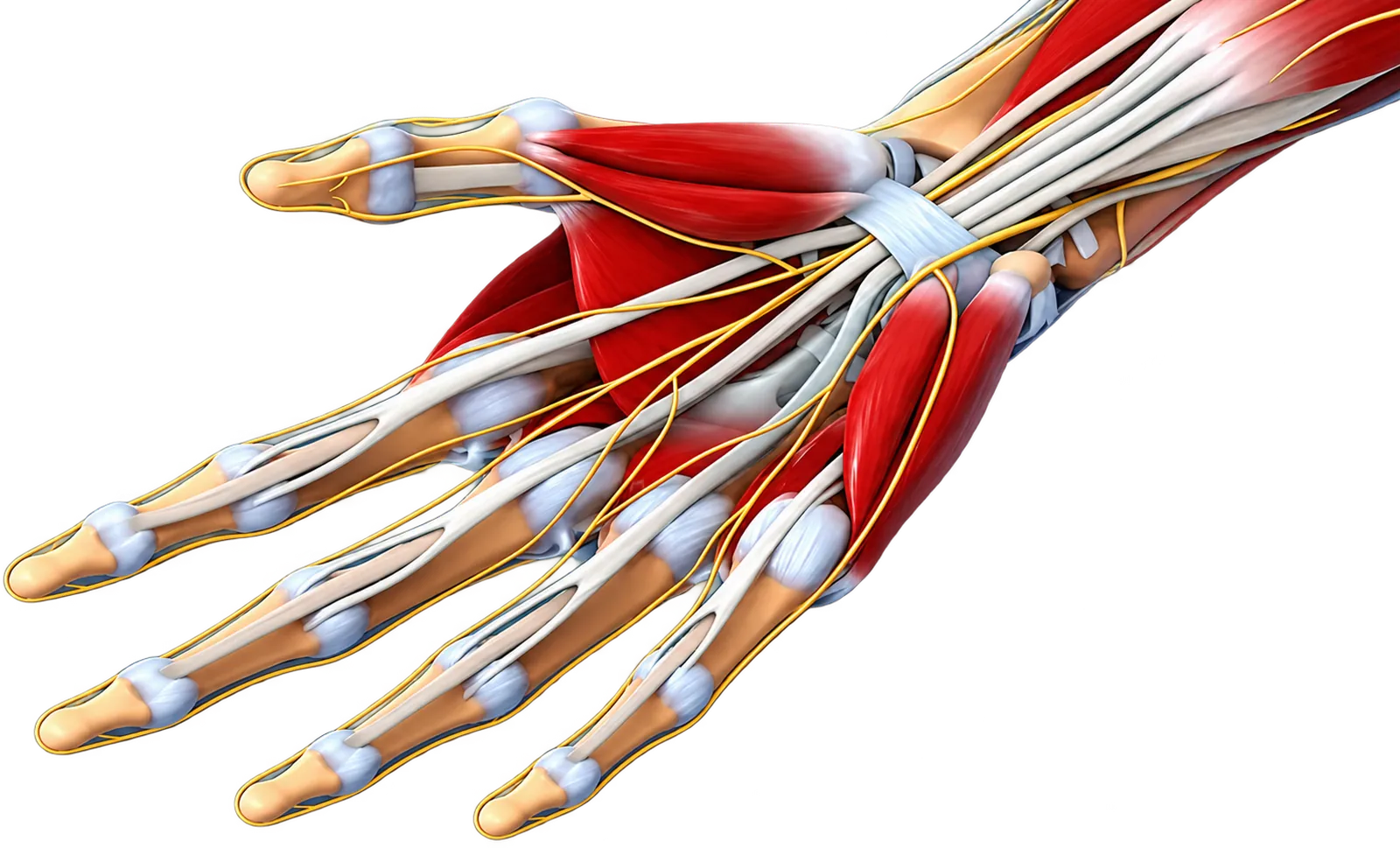
The carpal tunnel is a non-expandable space closed by a rigid ligament. Anything that increases the volume of its contents or the internal pressure compresses the median nerve. Pregnancy adds fluid retention and soft-tissue oedema, weight gain, and hormonal factors that alter the gliding tissues.
The picture is characteristic: symptoms mainly at night or in the early morning, predominantly in the thumb, index and middle fingers, often bilateral, appearing more readily in the third trimester. Finger swelling requiring ring removal is twice as frequent in symptomatic women. Marked oedema, hypertension or pre-eclampsia increase the risk.
Far more common than usually acknowledged
Figures vary with the definition used, but all describe a massive phenomenon. A systematic review reports an incidence of 7 to 43% when the diagnosis is confirmed by nerve conduction studies, and 31 to 62% when based on clinical criteria. A cohort of more than a thousand women followed from week twelve to one year postpartum reports a prevalence of 34% in the last trimester.
In other words, between one in three and one in two women experience these symptoms at some point in pregnancy. That does not make the condition inherently benign: it means the real question is sorting what will resolve from what will persist.
What actually happens after delivery
The good news dominates: the vast majority of symptoms ease quickly after birth, and about 85% of women are symptom-free by six weeks. The usual message — it will go away after delivery — is therefore true most of the time.
But it is incomplete. In the twelve-month cohort, one in six women with symptoms during pregnancy still reports them a year later. Other series, using broader definitions, find persistence in more than half of patients at one year and in about 30% at three years. Factors associated with persistence are early onset during pregnancy and high initial symptom severity.
One point is worth knowing: in some women, moderate residual symptoms remain stable for years, then worsen late enough to require surgical release two to sixteen years after the pregnancy. Symptoms that never fully disappear deserve follow-up, not dismissal.
Treatment during pregnancy
It is almost always non-surgical, and it works. A night wrist splint in neutral position is the first-line treatment: it prevents wrist flexion during sleep, when pressure inside the tunnel is highest. Simple measures help too — elevating the hands, avoiding prolonged flexed-wrist positions, adapting the workstation.
For severe, resistant symptoms, a corticosteroid injection can be discussed. In a reference series, of 26 conservatively treated patients with available follow-up, 25 improved and only 4 eventually had surgery.
Surgery during pregnancy remains exceptional. It is considered for motor deficit, permanent sensory loss, or pain that entirely prevents sleep — not for intermittent tingling.
After delivery: when to stop waiting
I suggest a simple rule. Reassessment at six weeks, then at three months. If symptoms have gone, the matter is closed. If they persist at three months with no trend towards improvement, waiting is no longer useful: this is the moment for nerve conduction studies and a treatment decision, because nerve recovery depends on how long the compression has lasted.
Breastfeeding is not an obstacle. Carpal tunnel release is a day-case procedure under local or regional anaesthesia of the upper limb, compatible with continued breastfeeding. The real constraint is practical rather than medical: carrying a newborn with an operated hand means arranging some help for a few days; on timescales, see the update on sick leave and getting back to normal.
Do not confuse it with "new mother's wrist"
Pain on the thumb side of the wrist, triggered by lifting the baby under the arms with the thumb spread, is not carpal tunnel syndrome: it is De Quervain's tenosynovitis, very common in the months after birth. It causes no tingling or numbness, and its treatment differs — relative rest, a thumb orthosis, changing the lifting technique, injection if needed. The two can coexist, which explains many uncertain postpartum diagnoses.