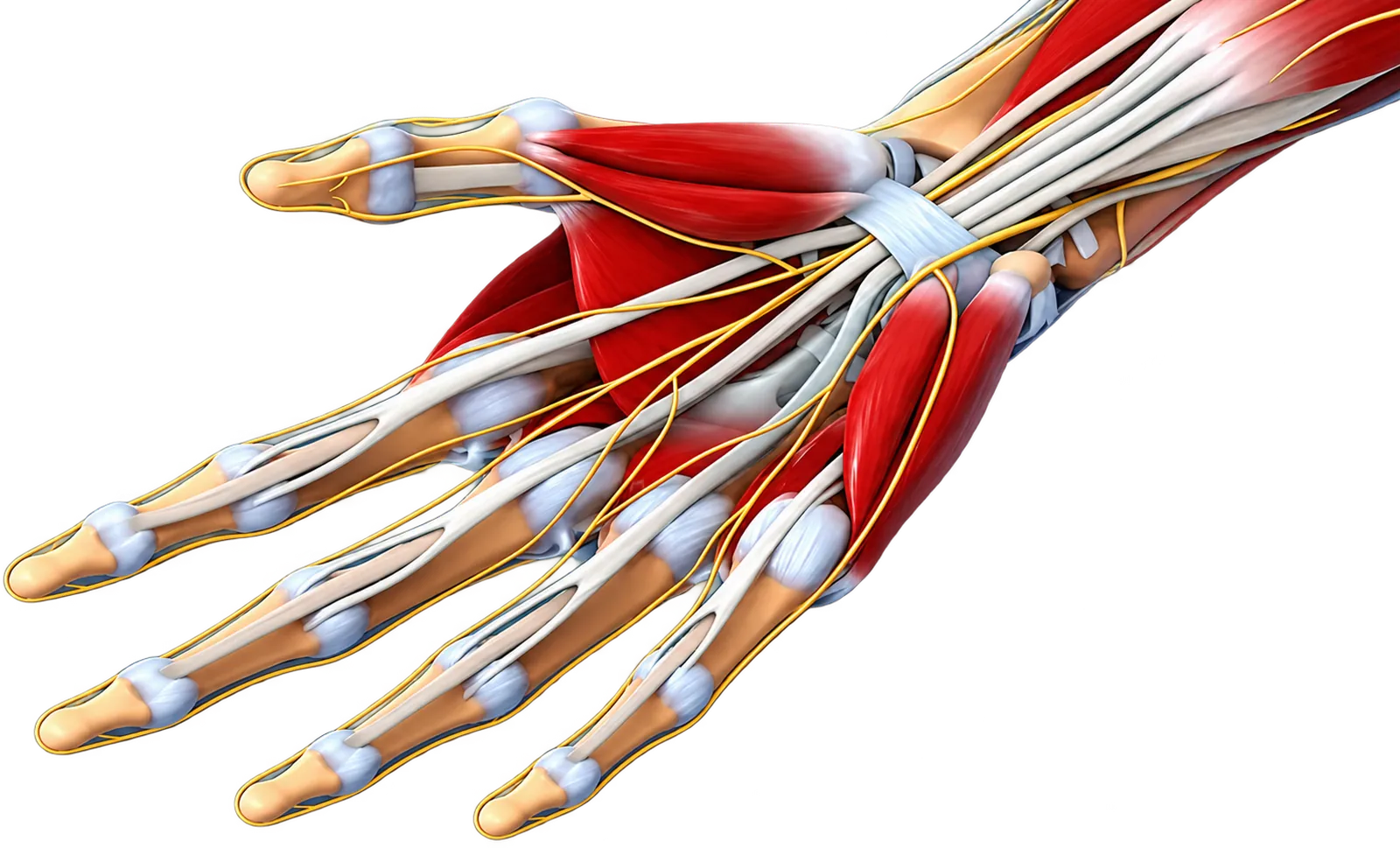
This is the first question asked in clinic, often before the one about pain. The honest answer is that there is no single duration: it depends on the procedure, the technique used and, above all, on what your job demands from your hand. Here are the official French benchmarks and the ones I use in practice.
What the official references say
For carpal tunnel syndrome, the French National Health Insurance publishes indicative durations, based on a reference document validated by the French National Authority for Health in 2013.
- After endoscopic release: one week may be enough for a job with little hand demand; up to 28 days for a hand-intensive job.
- After open surgery: about two weeks for a desk job; up to 45 days for physical work involving load carrying.
These durations are indicative, not regulatory. Your general practitioner, in liaison with the surgeon, prescribes and adjusts the leave. They also explain why the choice of technique is not cosmetic: the gap between a few-millimetre wrist scar and a three-centimetre palmar incision is counted in weeks of return to work.
Benchmarks for other procedures
Official references do not cover every condition. These are the orders of magnitude I give in clinic, to be adjusted case by case:
- Trigger finger, A1 pulley release: a few days to two weeks for desk work, three to four weeks for manual work. Finger mobilisation starts immediately and is part of the treatment.
- De Quervain's tenosynovitis: three to six weeks, longer if the job requires forceful thumb grip.
- Thumb base arthritis, trapeziectomy: the longest recovery of all. The medical treatment that precedes it is detailed in the update on finger osteoarthritis. Six to twelve weeks depending on the job, with initial immobilisation and prolonged rehabilitation.
These conditions often cluster in the same patient, which sometimes allows two sites to be treated in a single operation: see the update on peritrapezial conditions. One principle applies throughout: the scar does not decide, strength and endurance do. Palm sensitivity and grip strength are the last to return, well after the skin has healed.
What really lengthens or shortens the leave
Five factors matter more than anything else: whether the operated side is the dominant one, whether the job involves repetitive movements, forceful grip, vibration or load carrying, whether the employer can adapt the workstation temporarily, whether driving is needed for or to reach work, and the state of the nerve before surgery — a long-standing compression recovers more slowly.
Two options are underused: a phased return on therapeutic part-time work, and a pre-return visit to the occupational physician during the leave, which allows workstation adjustments to be prepared rather than discovered on day one.
Driving: what the law says, and the criterion that matters
No French text sets a driving delay after hand surgery. Article R412-6 of the Highway Code only requires every driver to remain at all times in a state and position to perform all required manoeuvres without delay. The judgement is therefore yours.
Two practical consequences. Driving with a rigid splint, or with a hand unable to perform an avoidance manoeuvre, exposes you to a fine. More importantly, in the event of an accident, your insurer may argue that you were not fit to drive and seek reimbursement from you.
The test I suggest: can you, without pain and without a drowsiness-inducing painkiller, hold the wheel with both hands, reverse while turning your head, and perform an emergency stop with a sharp steering movement? If not, it is too early. In practice: a few days after endoscopic release, often two to three weeks after open surgery, longer after a trapeziectomy. Start with short, familiar journeys.
Daily life, sport and DIY
Writing and typing are possible very early, in short sequences. Riding a motorcycle takes longer than driving a car. Swimming waits for complete healing, generally three weeks, as does gardening. Grip and contact sports, vibrating tools and heavy loads wait for strength to return: six weeks to three months depending on the procedure.
Pillar pain in the palm, common after carpal tunnel release, may make leaning on the hand uncomfortable for several weeks without indicating any problem. It justifies adapting the return, not postponing it.
If your condition is recognised as occupational
Carpal tunnel syndrome and several hand conditions are listed in French occupational disease table 57. Recognition changes compensation, coverage of care and job protection, but not the medical recovery time. The claim is filed with the health insurance fund with the initial medical certificate, and the file is best prepared before surgery rather than after.