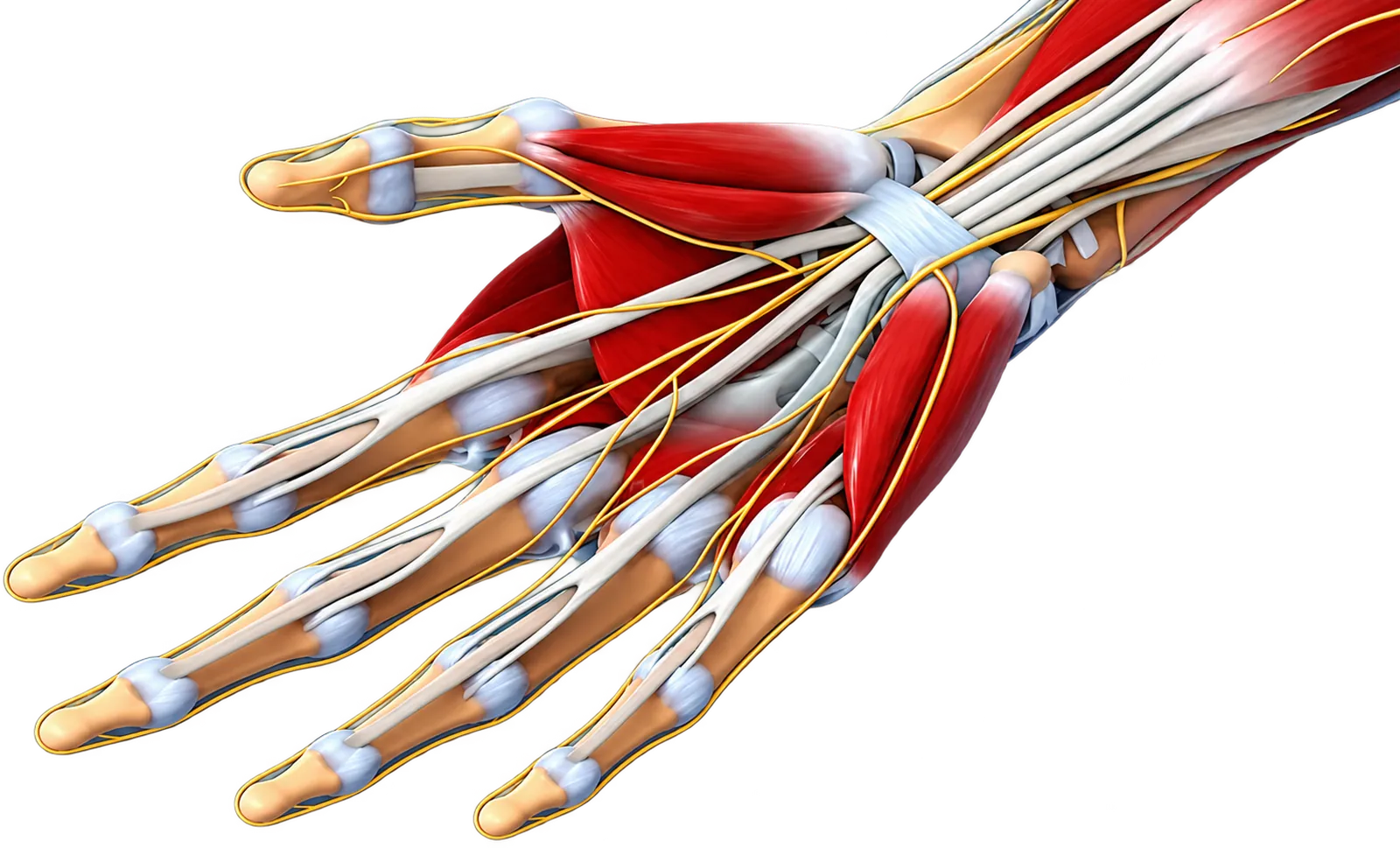
Carpal tunnel syndrome is the second most recognised occupational disease in France. On 2 September 2026, Santé publique France, the national public health agency, published the first national study describing the care pathway of people affected and their use — or not — of occupational disease recognition. Its results were widely reported in the press. This update puts them into perspective, recalls what recognition changes and does not change, and clarifies the surgeon's place in the process: they diagnose and treat the nerve compression, they do not decide administrative recognition.
What the September 2026 study shows
The study draws on the 2020 and 2021 editions of the Santé publique France Health Barometer, close to 24,000 people aged 20 to 64 interviewed by telephone. Its results come down to five figures.
- Slightly more than one person in ten reports having had carpal tunnel syndrome in the past five years — about 10% of women and 9% of men.
- More than seven in ten attribute their syndrome mainly (48%) or partly (26%) to their work.
- Among them, only one in ten reports having filed an occupational disease claim.
- When a claim was filed, it was accepted in almost eight cases out of ten.
- Even before any claim, only six people in ten say they consulted a doctor for the problem.
For comparison, carpal tunnel syndrome accounted for 21% of all occupational diseases compensated by the general social security scheme in 2023, more than 10,000 cases — just behind shoulder tendinopathies.
The message is not that every carpal tunnel is occupational. It is twofold: the link with work is frequent and often recognised when claimed, and a large share of those affected neither consult nor claim. The first reason given by those who did not claim is trivialisation of symptoms. The study also notes that seeing an occupational physician is associated with markedly more frequent claims.
{{FIGURE_1}}Why certain movements favour carpal tunnel syndrome
At the wrist, the median nerve passes through a non-expandable tunnel under a rigid ligament. Anything that durably raises pressure in that tunnel compresses it. The syndrome almost never has a single cause — age, sex, hormonal and medical factors weigh in — but certain occupational constraints contribute in a documented way:
- repeated or prolonged wrist extension, or repeated gripping;
- forceful work, particularly with the wrist flexed or extended;
- repeated or prolonged pressure on the heel of the hand;
- use of vibrating tools;
- cold exposure, which worsens symptoms.
So it is not "using one's hands a lot" that makes the link, but the type of movement, its repetition, intensity and duration of exposure. The most exposed sectors are known: food processing, retail, cleaning, construction, manufacturing, catering, agriculture, care work. But the job title alone is not enough: two people with the same title may have very different workstations.
What recognition requires
Under the French general scheme, carpal tunnel syndrome falls under occupational disease table 57, covering conditions caused by certain movements and postures. Three conditions apply: an established diagnosis, a regulatory delay between the end of exposure and the first medical finding, and habitual performance of tasks listed in the table — repeated or prolonged wrist extension or gripping, carpal support, pressure on the heel of the hand. The details, and cases not strictly meeting the table, are described on the dedicated page.
Two simple ideas to keep in mind. Medical diagnosis and administrative recognition are two distinct questions: one can have genuine carpal tunnel syndrome without recognition, and conversely recognition says nothing about severity. And recognition is not automatic: it must be claimed.
How to know whether my carpal tunnel is work-related
The answer comes from weighing several elements: symptoms — tingling in the thumb, index and middle fingers, night waking, loss of sensation or strength —; clinical examination; nerve conduction studies, which confirm the compression and measure its severity; workstation analysis — movements, frequency, effort, vibration, postures, duration of exposure —; and the patient's other contributing factors.
Two shortcuts should be avoided, in either direction. "I work with my hands, so my carpal tunnel is occupational": no, not automatically. "I have another risk factor, so work has nothing to do with it": no again. The analysis is individual, and that is precisely what the Santé publique France study invites us to do more often.
How to file a claim
The process is simple and worth knowing, since unfamiliarity with it is one reason for under-reporting. The doctor who considers an occupational origin issues an initial medical certificate describing the disease. The patient then files the claim with their health insurance fund, with that certificate. The fund assesses the file, checks the table conditions and notifies its decision.
The general practitioner, the occupational physician and, depending on the case, the specialist or hand surgeon intervene at different stages. The occupational physician holds a particular place: they know the workstation, can document exposure, and their involvement is associated with more frequent claims. The surgeon diagnoses, measures severity and treats; they can describe the condition in the certificate, but recognition does not depend on them.
{{FIGURE_2}}An occupational origin does not mandate surgery
This is a point I make systematically in clinic: occupational disease recognition and the surgical indication are two independent decisions. Treatment depends on the intensity and duration of symptoms, the examination, the severity measured by nerve conduction studies, and the response to medical treatment — night splint, adapted movements, injection. Surgery is considered when compression is significant, when symptoms persist despite medical treatment, or when nerve involvement risks incomplete recovery if one waits.
What recognition changes, and does not change
It changes compensation for sick leave, coverage of care, job protection and access to workstation adjustment or redeployment. It changes neither the medical recovery time, nor the surgical technique, nor the prognosis. Sick leave durations by job and return-to-work benchmarks are detailed in the update on sick leave, driving and getting back to normal.
In the vast majority of cases, carpal tunnel surgery does not require a change of occupation. It releases the nerve; workstation analysis with the occupational physician then limits the constraints involved — prolonged wrist postures, forceful movements, repetition, vibration — to protect the result obtained. The prevention page details these adjustments.
The essentials
Carpal tunnel syndrome can be favoured by work without automatically being an occupational disease; it can be recognised under table 57 when the conditions are met, and claims succeed in almost eight cases out of ten. Above all, the 2026 study shows that many people affected neither consult nor claim. Consulting establishes the diagnosis, measures severity and decides treatment; claiming is a separate step, which belongs to the patient, and which the initial medical certificate makes possible.